
People have many types of dreams. They may process the events of the day. They may be childhood memories or of people from the past. It is normal to dream but often dream content is difficult to understand. The way people dream is unique. For example, some people recall their dreams, frequently dream and talk or walk in their sleep. Some people have vivid and colourful dreams or ones that predict the future. Dreams can be memories from the past either conscious or unconscious.
Jung discussed the notion of primal archetypes unique to mankind. These archetypes may show up in our dreams in the form of the hero, mother or father for example. People also share common dream themes such as dreaming about having a test, showing up somewhere in your pajamas or naked, drowning or having loose or falling teeth. These dreams may have similar meaning for many people but one must be careful not to assign meaning to dreams without the personal context of the dreamer.
According to Jungian theories, dreams act as a bridge between our unconscious and conscious self. People often have material in their dreams that present in a symbolic or cryptic way. Carl Jung (1974) thought that dream material is often altered to protect us from memories or thoughts that may be damaging to our ego. For example, suppressed memories or hurtful thoughts may keep showing up in an altered format in dreams until we can understand them.
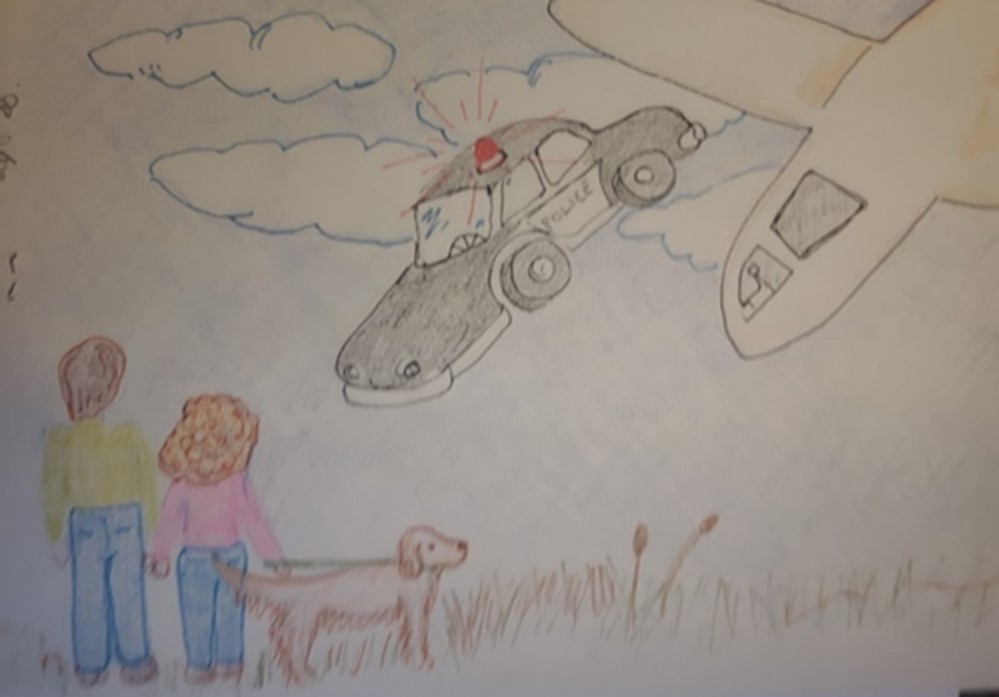
Brown (1986) shared research surrounding the fact that people experiencing mental stress had more recurrent, anxiety and nightmare dreams. The more mental and emotional well being a person had, the less disturbing dreams participants experienced. CBC news (2020) wrote an article on a large study done on pandemic dreams. They found common themes amongst people during this time. The artwork shared herein is from an art therapy participant. Initially she thought her dream was bizarre. She did not understand it. They stated that in her dream a police cars and airplane were flying at her and her family on a walk. They had to simply stand there and wait for the flying objects to land. They had no choice but to stay still and wait. They may be injured, and they may not. It was discovered during discussion of her art that the person felt uncertain about the restrictions due to the COVID-19 pandemic and felt anxious listening to the news.
During my thesis work on art therapy for discovering the messages from dream, it was amazing to me that dreamers participating in art therapy could better understand the messages in their dreams despite the dream’s unusual content. Many participants found that their recurrent dreams stopped when they could understand the message their unconscious was sending them. Art therapy is an especially useful tool for processing dream content and bringing forward information in order to be processed.
Brown R., Donderi D. (1986). Dream content and self-reported well-being among recurrent dreamers, past-recurrent dreamers, and non-recurrent dreamers. Journal of Personality and Social Psychology.50. 612– 623
CBC news, (2020, April). Pandemic anxiety causing vivid dreams, expert says. Retrieved from https://www.cbc.ca/news/canada/ottawa/pandemic-dreams-aiad-1.5540439
Jung, C. (1974). Dreams. Princeton, NJ: Princeton University Press.